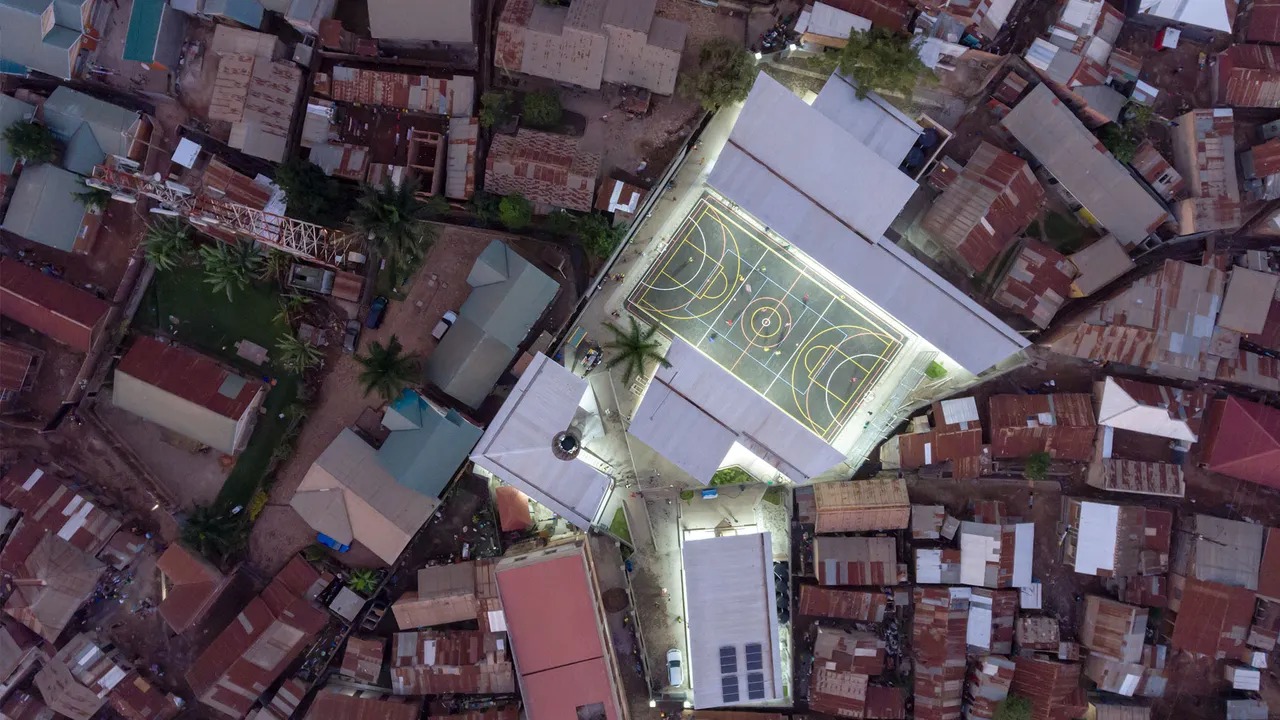
Case Study: Kamwokya Community Centre
Kampala, Uganda
Kere Architecture with JE Nsubuga and Associates


“Architecture is a wake-up call” according to Diebedo Francis Kere as he addresses his colleagues in the architecture field. This call to action comes from his belief that architecture has the potential to improve the lives of people and their communities at a foundational level.
Organized by the Kamwokya Christian Caring Community (a local non-profit that runs sports, arts, and leisure activities in the Kamwokya District) and the Ameropa Foundation (an international activist group that helps fund projects for marginalized communities), the Kamwokya Community Centre “aims to transform the community by becoming a source of inspiration and pride that in turn can create a sense of agency and ownership” in the community, according to Diebedo and his design team.
In the dense urban center of Kampala, community space is scarce. To make the most of the small open area available between homes and businesses, this project arranges many building programs and uses in a way that maximizes the little space available. In the small 17,000 sq foot (1600 sq meter) site, there is an indoor gym, an Internet cafe, classrooms, a music studio, offices, and a public sanitation facility, all tightly arranged around a central courtyard that functions as a public square and sports court.
In order to keep costs low and provide many of these public facilities, the buildings are kept simple utilizing locally available materials such as brick, corrugated steel, and wood. This use of material helps to connect the building into the architectural language of the neighborhood. The steel roofing and exposed brick resemble the DIY appearance of the adjacent buildings. However, the sculptural tower in the square provides a visual center and a contrast to the area.
Bringing in local craftspeople and working with the local Ugandan Studio (JE Nsubuga and Associates), Kere and his team developed the project understanding that the design process needed to include local knowledge and expertise. Keeping with the vernacular tradition of the surrounding neighborhood provided local craftspeople a chance to participate in the construction process. As a way to meet people where they are with the skills they already possess, it becomes easier to bring in local talent and to provide training on new building techniques. In this way, the design and construction process doubles as a community building and skill building exercise that can expand to other areas of the city as community members share what they have learned.
When Diebedo says architecture is a wake up call, he is telling us that good design is available to everyone if we approach architecture with a mindset that focuses on opportunities instead of limitations. The Kamwokya Community Centre provides us the jolt he is referring to. Instead of focusing on the limitations of the site and the available funding for the project, Diebedo chose instead to focus on the opportunities in working with local experts, including community members.


Works Cited
Astbury, J. (2022, December 27). Kéré architecture creates Kamwokya Community Centre in Uganda. Kéré Architecture designs community centre in Uganda to be “source of inspiration and pride”. DeZeen.
https://www.dezeen.com/2022/11/27/kere-architecture-kamwokya-community-centre-uganda
Elliott M. (2022, November 5). Kéré Architecture’s Uganda community centre provides safety and opportunity. Wallpaper.
https://www.wallpaper.com/architecture/uganda-community-centre-kere-architecture-uganda
Kere, D. F. (2022). Diebedo Francis Kere Biography. The Hyatt Foundation.
https://www.pritzkerprize.com/laureates/diebedo-francis-kere#laureate-page-2421
Maju, S. V. (2022, December 2). Kamwokya Community Centre: A continuum of Kéré Architecture’s humanitarian design. STIRworld.
https://www.stirworld.com/see-features-kamwokya-community-centre-a-continuum-of-kere-architecture-s-humanitarian-design
Pintos P. (2023, December 26). Kamwokya Community Center/ Kere Architecture. ArchDaily.
https://www.archdaily.com/991513/kamwokya-community-center-kere-architecture
Pritzker Architecture Prize. (2022). Diébédo Francis Kéré Receives the 2022 Pritzker Architecture Prize. Amazing Architecture.
https://amazingarchitecture.com/news/diebedo-francis-kere-receives-the-2022-pritzker-architecture-prize
Diebedo Francis Kere, Architect
Hometown: Gando, Burkina Faso
Pritzker Architecture Prize,2022
“I am hoping to change the paradigm, push people to dream and undergo risk. It is not because you are rich that you should waste material . It is not because you are poor that you should not try to create quality,” says Kéré . “Everyone deserves quality, everyone deserves luxury, and everyone deserves comfort. We are interlinked and concerns in climate, democracy and scarcity are concerns for us all .” -Kere
“I grew up in a community where there was no kindergarten, but where community was your family. Everyone took care of you and the entire village was your playground. My days were filled with securing food and water, but also simply being together, talking together, building houses together. I remember the room where my grandmother would sit and tell stories with a little light, while we would huddle close to each other and her voice inside the room enclosed us, summoning us to come closer and form a safe place. This was my first sense of architecture.” -Kere
